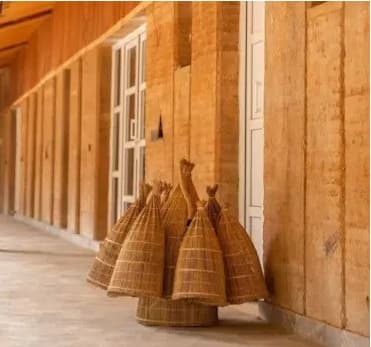
In the modern era of industrial construction, the art of building with earth is often viewed through a lens of nostalgia. However, at Ramro Mato Pvt. Ltd., we treat soil not as a primitive relic, but as a sophisticated engineering material.
Our work on projects such as Bagaicha Adventure Resort (BAR) serves as a benchmark for how rigorous scientific methodology can transform raw earth into a high-performance, sustainable built environment.
This long-read explores the four pillars of our technical process, derived from our documented research, laboratory testing, and real-world site applications.
I. Material Science: The Taxonomy of Soil
Not all earth is created equal. The success of a structural earthen wall depends entirely on the grain-size distribution and mineralogical composition of the source material.
Sourcing and Mapping
We conduct extensive field surveys to identify viable soil deposits for construction. Our research categorizes samples (labeled S₀ through CS₅) according to geographic coordinates and hauling distance from the project site — ranging from immediate excavation zones (0 km) to regional sourcing areas extending beyond 58 km.
Soil Classification
Through laboratory sieve analysis and sedimentation testing, we determine the proportion of:
- Clay
- Silt
- Sand
- Gravel
A structurally suitable building soil must contain sufficient clay to function as a natural binder, while avoiding excessive plasticity that may lead to shrinkage cracking during curing and drying.
The Sieve Curve
Each soil sample is mapped against ideal gradation curves to achieve maximum packing density and structural stability.
If a local soil is too “lean” (overly sandy) or too “fat” (excessively clayey), we engineer the material through controlled blending with supplementary aggregates and stabilizers to achieve an optimized balance.
II. Standardized Fabrication: From Raw Soil to Structural Block
To move from “mud” to “masonry,” fabrication must be standardized so every unit performs predictably under structural load.
Stabilized Compressed Earth Blocks (SCEB)
By applying mechanical compression to a moist soil-stabilizer mix, we significantly reduce the material’s void ratio. This increases density, compressive strength, and resistance to water penetration.
Geometry and Consistency
We utilize standardized molds — typically 150 mm cubes and cylindrical test specimens — to produce uniform structural units.
This precision allows:
- Thinner mortar joints
- Improved load transfer
- Cleaner architectural finishes
- Higher construction consistency
The result reflects our commitment to meticulously crafted earthen architecture.
The Role of Moisture
The Optimum Moisture Content (OMC) is one of the most critical parameters in earthen construction.
Too much water leads to shrinkage and deformation, while insufficient moisture prevents proper hydration and bonding of stabilizers.
Every production batch is calibrated to maintain this equilibrium, ensuring long-term structural integrity.
III. Structural Rigor: Validating Safety Through Testing
In a seismically active region such as the Himalayas, faith-based construction is not an option. Earthen structures must meet measurable engineering standards.
Compression Testing
We utilize a Universal Testing Machine (UTM) to crush stabilized blocks to failure and determine their ultimate compressive strength.
This enables us to calculate safe load-bearing capacities for:
- Load-bearing walls
- Multi-storey structures
- Structural partitions
- Hybrid earthen systems
Stress Analysis
Using advanced finite element modeling and structural simulation, we generate shear stress diagrams that visualize how combined loads move through earthen walls.
These load combinations include:
- Dead Load (DL)
- Live Load (LL)
- Seismic Forces
This computational analysis allows us to optimize wall thickness, reinforcement strategies, and structural geometry.
Deformation Mapping
By evaluating deformation under critical load combinations such as 1.5(DL + LL), we ensure buildings remain within safe serviceability limits.
This prevents:
- Structural cracking
- Excessive settlement
- Wall instability
- Long-term deformation
The outcome is a durable structure engineered for decades of performance.
IV. Site Integration: The Practitioner’s Execution
The final stage is the translation of laboratory research into a sustainable built environment. This is where engineering converges with craftsmanship.
Thermal Mass Management
Earthen walls — typically ranging from 350 mm to 450 mm thick — provide exceptional thermal mass.
These walls naturally regulate indoor temperatures by:
- Absorbing heat during the day
- Releasing heat slowly at night
- Reducing indoor temperature fluctuation
- Minimizing reliance on mechanical heating and cooling systems
This passive thermal performance is particularly valuable for eco-resorts and sustainable hospitality projects.
Contextual Aesthetics
Because the material is sourced directly from the site or surrounding geography, each building possesses a unique geological identity.
The architecture becomes a refined extension of the land itself — contextual, grounded, and regionally authentic.
Meticulous Supervision
Our role as practitioners extends far beyond design documentation.
We supervise:
- Layering and compaction of rammed earth
- Block curing procedures
- Moisture regulation
- Material consistency
- Site execution quality
This ensures the “as-built” structure faithfully matches the “as-designed” engineering model.
Conclusion: The Future is Grounded
At Ramro Mato Pvt. Ltd., we believe the path toward a sustainable future lies beneath our feet.
By combining:
- Rigorous material science
- Standardized fabrication
- Computational structural analysis
- Skilled site execution
we provide an alternative to carbon-intensive industrial construction.
The result is architecture that is:
- Structurally engineered
- Environmentally responsible
- Energy efficient
- Contextually rooted
- Built to last for generations
Earth is not a material of the past.
It is one of the most advanced materials available for the future of sustainable construction.